Need help selecting the right controls? Talk to our specialists — response within 24 hours.

HVAC Control Solutions Tailored to Your Application

Every building and process has unique thermal requirements. We match control strategies to your specific needs, so you get the right level of precision, integration, and monitoring without overcomplicating the system.

Get a Free Consultation
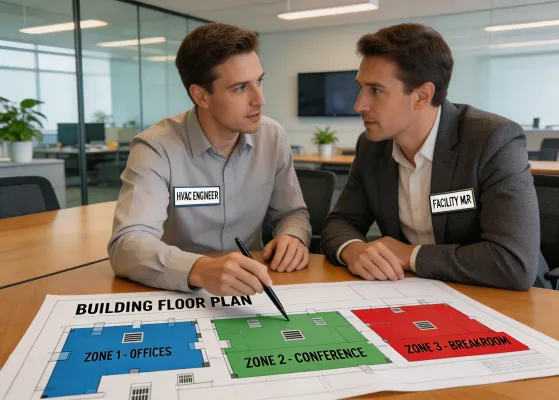
HVAC control solutions consultation

Solutions by Application

Select your application below to see how our controls platform addresses your specific challenges.

Commercial Building Automation

Integrated BMS platforms that unify HVAC, lighting, and access control into a single dashboard. VAV zone control, occupancy-based scheduling, and energy sub-metering help reduce operating costs while maintaining tenant comfort across multi-zone facilities.

Discuss Your Project

Data Center Precision Cooling

High-accuracy temperature sensors (plus or minus 0.3 degrees C) and humidity sensors (plus or minus 2% RH) paired with fast-response electronic expansion valves deliver the tight tolerance bands that server environments demand. Our controllers support hot aisle / cold aisle containment strategies and integrate with DCIM platforms via BACnet IP.

A typical Tier III data center deployment uses our DC-series controllers with redundant sensor inputs and automatic failover logic. In a 2023 deployment for a 2 MW colocation facility in Frankfurt, the controls system maintained server inlet temperatures within 0.5 degrees C of setpoint across 480 racks while reducing cooling energy consumption by 22% through economizer mode optimization.

Discuss Your Project

Food & Beverage Process Control

HACCP-compatible monitoring with continuous temperature logging, configurable alarm thresholds, and audit-ready data export. Our refrigeration controllers manage defrost cycles, compressor staging, and door open alerts for walk-in coolers and blast freezers.

Discuss Your Project

Pharmaceutical Clean Room Control

GMP-validated temperature and pressure differential control for clean rooms and storage areas. Our systems provide 21 CFR Part 11 compatible electronic records, supporting your qualification and validation documentation requirements.

Discuss Your Project

Cold Chain Warehouse Monitoring

Multi-zone temperature monitoring across large warehouse footprints with wireless sensor networks. Cloud dashboards provide real-time visibility across multiple sites, with SMS and email alerts when any zone drifts outside tolerance.

Discuss Your Project

Industrial Process Cooling

Robust controllers for chiller plant management, cooling tower sequencing, and heat exchanger temperature control in chemical, petrochemical, and manufacturing environments. Support for 4-20mA, RTD (Pt100/Pt1000), and thermocouple (J/K/T type) inputs with 16-bit ADC resolution.

For process cooling applications, our controllers manage approach temperature optimization on shell-and-tube and plate heat exchangers, targeting approach temperatures as low as 2 degrees C to maximize heat transfer efficiency while preventing fouling acceleration. Safety interlock integration supports emergency shutdown sequences per IEC 61511.

Discuss Your Project

Technical Trade-Offs Worth Understanding

Choosing the right control strategy involves trade-offs. Here are two decisions we frequently help customers navigate.

Variable Speed (Inverter) vs. Fixed Speed Compressor Control

Inverter-driven compressors modulate capacity to match real-time load, delivering 30-50% energy savings at part load and precise temperature control. They are the preferred choice for applications with fluctuating demand, such as data centers and multi-zone commercial buildings.

Fixed-speed compressors cost less upfront, have simpler control requirements, and are easier to maintain. In constant-load applications like industrial process cooling or dedicated ice-making lines, fixed-speed units often provide equivalent lifecycle value because the compressor runs near full capacity most of the time.

Our recommendation: Evaluate your facility's load profile before deciding. We offer 30-day monitoring with portable data loggers to help you quantify part-load hours and calculate actual payback periods for inverter upgrades.

Air-Cooled vs. Water-Cooled Chiller Control Strategies

Air-cooled chillers have lower installation costs and eliminate cooling tower maintenance. They consume no water, making them suitable for water-scarce regions and rooftop installations. Typical COP ranges from 2.8 to 3.5.

Water-cooled chillers achieve higher COP values (5.0-6.0), offer better part-load efficiency via condenser water temperature reset, and typically last longer. For installations above 500 TR, water-cooled systems generally deliver lower total cost of ownership over a 15-20 year lifecycle.

The controls angle: Water-cooled systems require more sophisticated controls — cooling tower sequencing, condenser water reset, and variable-flow pumping loops. Our BMS platforms handle both architectures, but we help you understand the control complexity trade-off before committing.

Verify Before You Commit

We believe you should test our controls in your environment before making a full commitment. Here is how we make that possible.

Free Sample Controllers

Request evaluation units of our thermostats, sensors, or BMS controllers for a 30-day bench test in your facility. We ship to qualified engineers at no cost.

Application Engineering Review

Our controls engineers conduct a free one-hour technical review of your building plans and existing infrastructure, providing a written recommendation with specific model numbers, quantities, and wiring diagrams.

Pilot Zone Deployment

For BMS projects, we recommend a pilot zone covering 5-10% of your building before full rollout. This validates sensor accuracy, network stability, and integration with your existing systems under real operating conditions.

The Controls Upgrade Difference

See how upgrading from legacy pneumatic or standalone controls to an integrated digital platform changes your daily operations.

Before: Legacy Controls

  • Manual setpoint adjustment at each unit
  • No centralized visibility across zones
  • Reactive maintenance — fix after failure
  • Energy waste from constant-speed equipment
  • Paper-based temperature logs for compliance

After: Johnson Controls BMS

  • Remote setpoint management from any device
  • Real-time dashboards for every zone and sensor
  • Predictive alerts based on trend analysis
  • Optimized energy use with demand-based control
  • Automated digital logs with audit trail export

Not Sure Which Solution Fits?

Tell us about your facility and goals. Our controls specialists will recommend an approach that fits your timeline, budget, and technical requirements.

Schedule a Consultation